Jesu salvator saeculi
4:24演奏家 The Cardinall’s Musick · Andrew Carwood
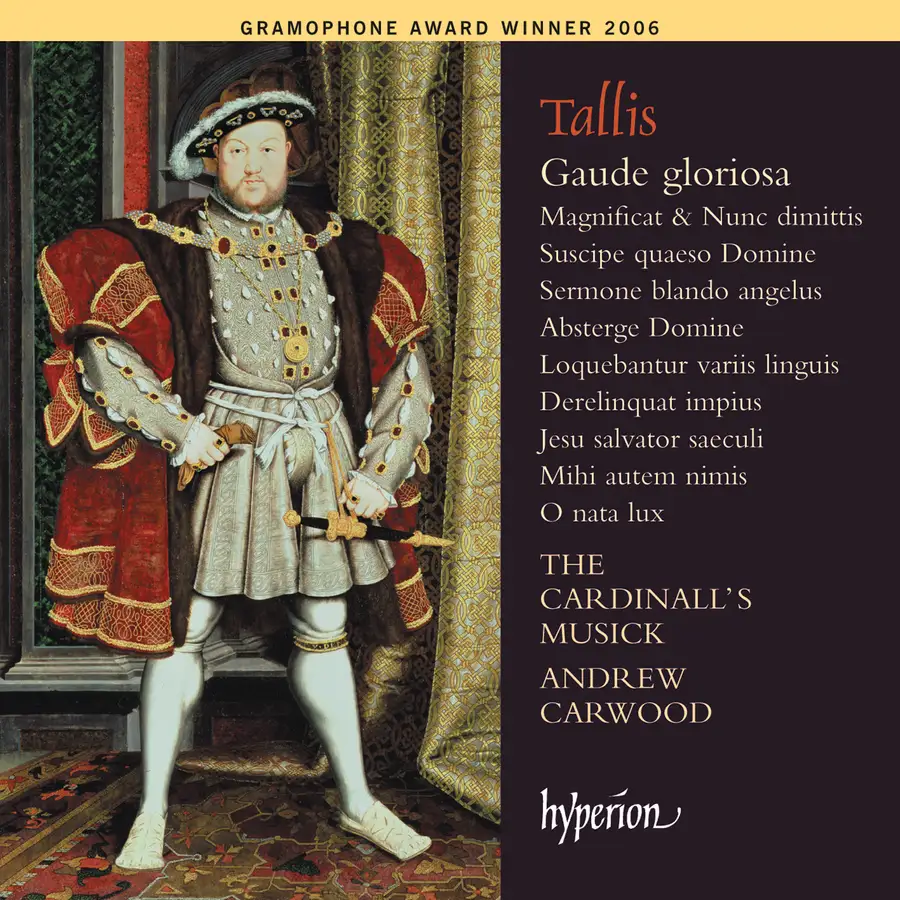
Andrew Carwood 执棒 The Cardinall’s Musick 演绎的塔利斯作品,是探索英国文艺复兴复调巅峰的权威首选。
作为 The Cardinall’s Musick 加盟 Hyperion 的首张专辑,此碟聚焦塔利斯在 Cardinal Wolsey 时期的创作。核心曲目 Gaude gloriosa 长达近二十分钟,被视为该体裁的巅峰之作,展现了作曲家对圣母玛利亚文本坚定而雄辩的回应,结构成熟且充满热忱。
来源:Booklet PDF(作品说明改写)
Hyperions record of the month for July celebrates the (probable) 500th anniversary of the birth of Englands first superstar composer, Thomas Tallis, and welcomes the signing to the label of The Cardinalls Musick and Andrew Carwood. In a fifteen-year history The Cardinalls Musick has progressively built an enviable reputation for excellence. Some twenty recordings on the ASV Gaudeamus label have seen accolades from around the world, including a Gramophone Award and a Diapason dOr, while in the concert hall and workshop the group has consistently displayed innovation and a freshness of approach, whether tackling contemporary works (many of them commissions) or sharing the fruits of years of research into the music of the English Renaissance. With this first recording for Hyperion, The Cardinalls Musick turns to the period of its namesake, Cardinal Wolsey, and specifically to the music of Thomas Tallis. Gaude gloriosa takes centre stage. One of a series of monumental and extended motets (each lasting getting on for twenty minutes), this should be regarded as the summation of the genrewhereas Talliss earlier attempts such as Salve intemerata or Ave Dei Patris filia can seem to ramble somewhat, in Gaude gloriosa we find a sure-footed and eloquent response to an unusual text in honour of the Virgin Mary, and a work which takes singer and listener alike into a world of unremitting fervour. Other works on this recording include the famous Loquebantur variis linguis and O nata lux settings, the five-voice Latin Magnificat and Nunc dimittis, and Suscipe quaeso Dominewhere a particularly gloomy text (thought to have been written to mark Englands reconciliation with Rome on the accession of Mary Tudor) elicits from Tallis some truly extraordinary and rhetorical effects with harmonic shifts which are every bit as shocking today as they must have been at the works first performance in 1554. Future plans for The Cardinalls Musick on Hyperion include the completion of their on-going remarkable series encompassing the complete Latin church music of William Byrd.
演奏家 The Cardinall’s Musick · Andrew Carwood
演奏家 The Cardinall’s Musick · Andrew Carwood
演奏家 The Cardinall’s Musick · Andrew Carwood
演奏家 The Cardinall’s Musick · Andrew Carwood
演奏家 The Cardinall’s Musick · Andrew Carwood
演奏家 The Cardinall’s Musick · Andrew Carwood
演奏家 The Cardinall’s Musick · Andrew Carwood
演奏家 The Cardinall’s Musick · Andrew Carwood
演奏家 The Cardinall’s Musick · Andrew Carwood
演奏家 The Cardinall’s Musick · Andrew Carwood
演奏家 The Cardinall’s Musick · Andrew Carwood
演奏家 The Cardinall’s Musick · Andrew Carwood
本页推荐由 Presto 新片信息、iTunes/Apple 链接与曲目、QQ 音乐链接、以及可用官方 Booklet 链接与内容改写自动生成;Presto 数字手册标记不等同于可公开访问的 PDF,本站仅链接到官方来源。
当前置信度为 95%,只表示资料和推荐依据的完整度, 不是星级,也不是对演奏或录音质量的审美评分。